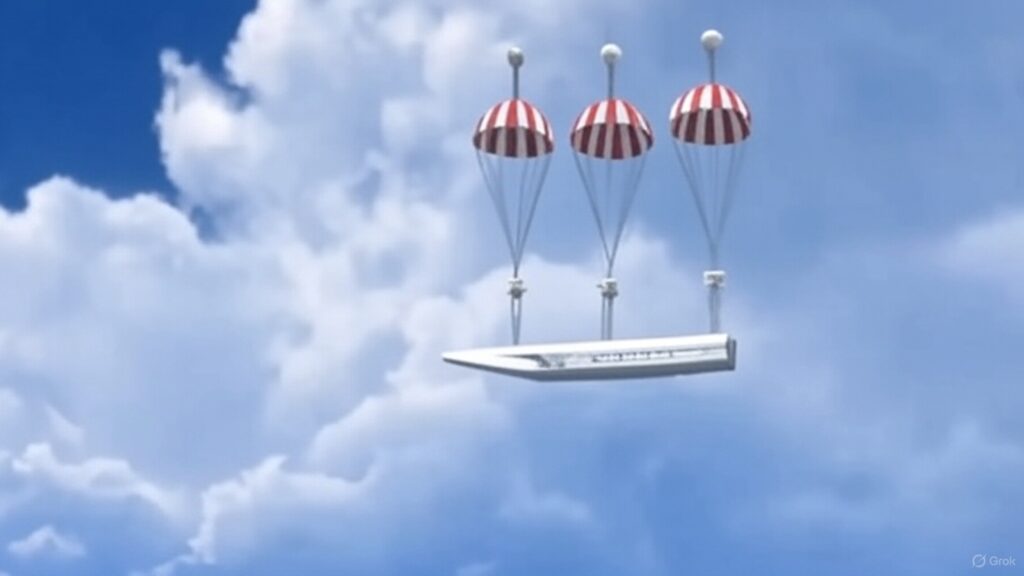
Imagine this: A commercial jet loses control mid-air. Alarms blare, oxygen masks drop, and panic spreads. But instead of a catastrophic crash, something unexpected happens—giant safety balloons deploy from the fuselage, cushioning the impact as the aircraft gently settles to the ground or water. Incredibly, all passengers survive.
While this may sound like science fiction, scientists and engineers are already experimenting with similar technology that could revolutionize aviation safety in the coming decades.
The Concept: What Are Safety Balloons?
Safety balloons refer to inflatable cushioning systems that deploy during an aircraft emergency to reduce crash impact and improve survivability. Inspired by car airbags, space re-entry systems, and inflatable boats, these systems are designed to:
- Absorb crash impact
- Provide flotation in water landings
- Create an emergency buffer zone around the fuselage
- Assist in rapid evacuation and rescue
Current Experiments and Developments
Here are real-world experiments and research projects exploring inflatable or crash-mitigation systems:
1. NASA’s Inflatable Reentry Technology
NASA has developed the Hypersonic Inflatable Aerodynamic Decelerator (HIAD) — a giant inflatable heat shield used to slow down spacecraft entering planetary atmospheres. While meant for space travel, this technology could inspire balloon-based deceleration for aircraft in emergencies.
2. Airbus “Project Dragonfly”
Airbus is testing automated emergency systems under Project Dragonfly, which includes controlled emergency landings and automated safety protocols. Though not specifically inflatable balloons, Airbus has shown interest in deployable systems like drone-guided parachutes and emergency flotation aids for future aircraft.
3. EHang VT-30 (Autonomous Air Taxi)
Chinese air mobility company EHang has integrated inflatable air-cushion landing gear and auto-landing systems in its prototypes, especially for rough or emergency landings. This showcases how inflatable tech is already entering passenger-grade aerial vehicles.
4. Russian Engineers Propose Full-Aircraft Parachute with Balloon Cushioning
Researchers in Russia proposed a concept involving a giant parachute system combined with under-fuselage inflatable airbags. This dual-layer system could decelerate an aircraft and cushion its landing on solid ground or water. Simulations showed significant reduction in crash forces.
5. Survivable Aircraft Design at TU Delft (Netherlands)
Researchers at Delft University of Technology are designing “modular crash pods” that could be ejected and landed safely using parachutes and inflatable bags. These passenger cabins would separate during a catastrophic event, keeping passengers alive on impact.
How It Would Work
A futuristic safety balloon system for airplanes could involve:
- Crash Prediction AI
Detects imminent danger using real-time data and triggers deployment. - Inflatable Pods or Belly Balloons
High-pressure balloons deploy from under the fuselage, wings, or engine areas. - Impact Absorption
Balloons reduce terminal velocity and absorb ground or water shock. - Emergency Flotation
In water landings, the same system keeps the aircraft afloat longer. - High-Visibility Rescue Aids
Bright colors and reflective materials improve visibility for rescue teams.
Benefits of Safety Balloons
- Enhanced survival in crash scenarios
- Support for emergency landings on uneven terrain or water
- Rapid deployment within seconds
- Supplement to seatbelts, life vests, and evacuation slides
Challenges and Next Steps
Of course, many technical hurdles remain:
- Weight vs. Benefit: Balloons must be lightweight but durable.
- Deployment Speed: Inflation must occur in under 3 seconds.
- Cost: Adding these systems to every aircraft must be cost-effective.
- Air Traffic Regulations: Must comply with international aviation safety standards.
However, with continuous investment in materials science, AI-driven crash prediction, and aerospace safety research, we may see such systems on future commercial aircraft within 15–20 years.
The Bigger Picture: Toward Zero Fatalities in Air Travel
Air travel is incredibly safe, but the goal is zero fatalities—and safety balloons could be a critical step forward. As cities prepare for flying taxis, suborbital flights, and space tourism, we need bold ideas to keep the sky as safe as possible.
Imagine a future where even a severe failure doesn’t mean tragedy—because inflatable wings, cushions, or escape pods keep everyone alive.
Final Thoughts
While safety balloons for commercial aircraft are still in the experimental phase, the progress in related technologies shows strong promise. With proper funding, testing, and collaboration between aerospace giants and startups, we could turn today’s imagination into tomorrow’s life-saving innovation.
So the next time you hear “safety first” before takeoff, know that somewhere in a lab, engineers are working to make that more than just a phrase—it could mean every passenger lives to tell the tale.