The Three Eras of Digital Connection
Every generation of the internet has redefined one basic question: who are you actually talking to when you go online?
Era One: The Public Square
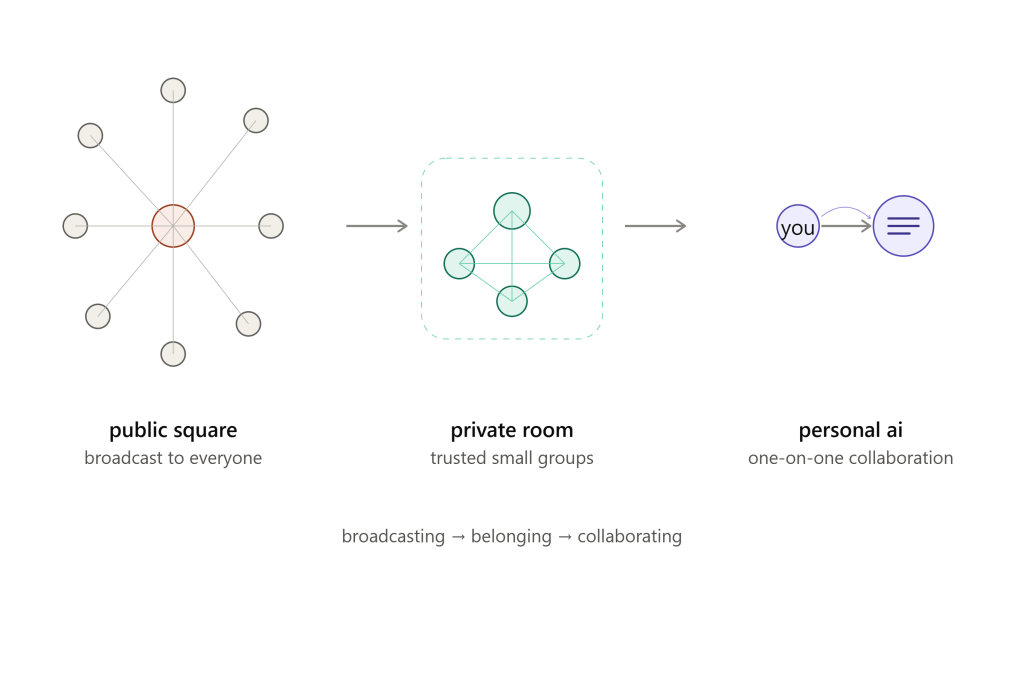
The first great social wave — Facebook, Twitter, Instagram — was built on a simple idea: put your life on a stage and let anyone walk by. You posted a photo, a status, an opinion, and it went out to hundreds or thousands of people at once, most of whom you barely knew. This was the internet as public square. It was loud, performative, and driven by likes, followers, and algorithmic reach. Identity became something you curated for an audience.
It was revolutionary — for the first time, anyone could have a voice that reached beyond their physical community. But it came with a cost. Public sharing meant public judgment. Every post was filtered through the question, “How will this look to everyone who sees it?”
Era Two: The Private Room
As people grew tired of performing for the crowd, communication retreated into smaller, trusted spaces. WhatsApp, Telegram, and group chats became the new default. Instead of broadcasting to the world, people started curating small circles — family groups, close friends, work teams. This was the internet as private room: fewer eyes, more trust, and conversations that felt more like real relationships than public performances.
This shift wasn’t just aesthetic. It reflected something deeper — a desire for meaningful connection over sheer reach. Engagement metrics started to matter less than genuine, ongoing relationships within smaller circles.
Era Three: The Personal Collaborator
Now a third shift is emerging, and it’s arguably the most fundamental one yet. Instead of connecting to a network of people — public or private — many of our most important digital interactions are starting to happen with a single, personal AI assistant.
This isn’t about broadcasting to a crowd, and it isn’t even about chatting with a private group. It’s a one-on-one collaboration between a person and an intelligent agent that:
- Learns alongside you, adapting to how you think and what you already know
- Works with you, helping you draft, plan, code, or analyze in real time
- Creates with you, turning half-formed ideas into finished output
- Helps you decide, offering perspective without needing to be persuaded, impressed, or managed
Why This Shift Matters
1. From Performance to Productivity
Public platforms rewarded performance — the best-looking post, the most viral take. Private groups rewarded belonging. Personal AI rewards neither. There’s no audience to impress, no algorithm to game. The relationship is purely functional: you show up with a need, and the interaction is judged by whether it actually helped.
2. Infinite Patience, Zero Judgment
A friend group has limits — you can only ask so many questions before you’re “that person” in the chat. An AI assistant doesn’t get tired, doesn’t judge, and doesn’t have its own agenda competing with yours. That changes what people are willing to ask for help with, and how often.
3. Personalization at a Scale Humans Can’t Match
Your AI assistant can, over time, understand your writing style, your business context, your goals, and your constraints — and apply all of that consistently, instantly, whenever you need it. No human collaborator, however close, can hold and instantly recall that much context on demand.
4. A New Kind of Privacy
Ironically, the most private digital space isn’t a group chat with people you trust — it’s a conversation with an assistant that has no social stake in what you share. You’re not managing anyone else’s perception of you. That creates room for more honest thinking, more exploratory questions, and less self-censorship.
What Gets Left Behind — and What Doesn’t
This shift doesn’t mean public networks or group chats disappear. Broadcasting still matters for reaching wide audiences, and group chats still matter for real relationships. But the center of gravity of daily digital interaction is moving toward something more intimate and more useful: a single, ongoing collaboration between a person and their own AI.
The public square gave us reach. The private room gave us trust. The personal AI era promises something different again — leverage. Not just staying connected, but actually getting things done, learning faster, and making better decisions, one conversation at a time.
The Bigger Picture
If this trend continues, the defining relationship of the next internet era won’t be “you and your followers” or even “you and your friends.” It’ll be “you and your assistant” — a collaborator that’s always available, always contextual, and increasingly central to how people learn, work, and think.
The question worth asking isn’t whether this shift will happen — it’s already underway. The real question is: what kind of relationship do you want to have with the AI that increasingly sits at the center of your digital life?