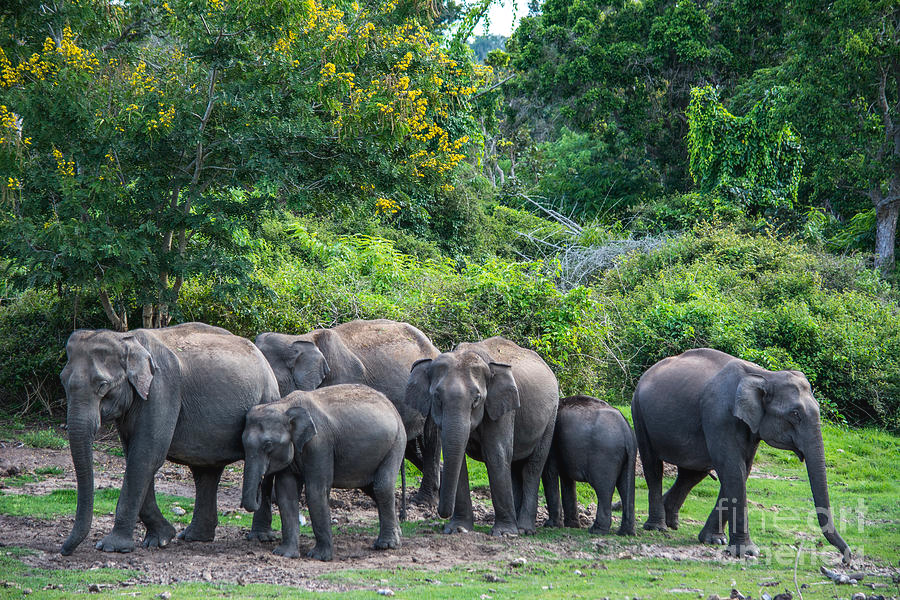
Hundreds of wild elephants converge on one ancient reservoir every dry season
Every year, as Sri Lanka’s dry season tightens its grip on the North Central Province, one of Asia’s greatest wildlife spectacles unfolds at Minneriya National Park. Known simply as “The Gathering,” it draws elephants from the surrounding forests in numbers rarely seen anywhere else on the continent — and it’s been happening, in one form or another, for centuries.
Why It Happens
As the dry season advances, the smaller streams and forest pools that elephants rely on for most of the year begin to disappear. The Minneriya Tank — an ancient reservoir built by King Mahasen around the 3rd century CE, originally for irrigation — is one of the few water sources in the region that holds through the dry months. As the tank’s water level drops, it exposes wide bands of fresh grass along its banks, drawing elephants in from the surrounding dry-zone forests to drink, graze, and socialize.
As Sri Lanka’s dry season sets in, wild elephant herds begin their seasonal movement in search of water and grazing. Rather than wandering at random, herds tend to follow well-worn paths — the same forested corridors used by their mothers and grandmothers before them. In the northwest, some of these seasonal movements bring herds within range of the Munneswaram area, where remaining pockets of forest and tank-fed wetlands offer refuge as inland water sources dry up further east.A Seasonal Dry-Season Route (illustrative)Interior forestTransit corridorMunneswaram & coastal beltDry-season startMunneswaram area (NW)Simplified for illustration — actual routes vary by herd, rainfall, and local corridors.
A Corridor, Not Just a Destination
Minneriya doesn’t stand alone. It’s connected to neighbouring Kaudulla National Park by a recognised elephant corridor, allowing herds to move freely between the two protected areas rather than being boxed into a single park. This kind of connected habitat is exactly what conservationists point to as essential for the Gathering to keep happening — fragment the corridor, and the migration itself is put at risk.
Best Time to Watch
Elephants tend to stay in the tree line during the heat of the day, emerging onto the open grassland as the afternoon cools — so a late-afternoon safari gives the best chance of seeing the herd at full size, grazing and socializing together as the sun sets over the tank.
Centuries after King Mahasen built it to irrigate rice paddies, his reservoir has become something else entirely: a lifeline for one of the last great elephant gatherings left in Asia.
This kind of route “memory” isn’t instinct alone — it’s passed down through generations by the herd’s matriarch, the oldest and most experienced female, who leads younger elephants along the same paths she once followed as a calf. Over decades, this builds a kind of living map of water holes, safe river crossings, and fruiting trees that the whole herd relies on.
Female elephants typically stay with their birth herd for life — so ecological knowledge of the land stays “in the family,” compounding across generations.
Similar gatherings are also said to occur elsewhere in the island, though far less documented. Residents in the Pallama–Chilaw area, on the northwestern coast, report elephants appearing seasonally around August and September — a pattern that, unlike Minneriya’s well-studied Gathering, hasn’t been captured in wildlife surveys or conservation literature. If accurate, it would suggest a smaller, lesser-known dry-season movement worth further study — but for now it remains local knowledge rather than a documented phenomenon.As development and new roads increasingly cross these traditional corridors, herds moving toward areas like Munneswaram are a reminder of how much of Sri Lanka’s elephant behavior is shaped by long-held, inherited knowledge of the land — and how fragile that knowledge becomes when the landscape changes faster than the elephants’ internal maps can adapt.