
BYD (Build Your Dreams), the Chinese electric vehicle giant, has been making waves across the globe with its affordable EVs, strong battery technology, and rapid expansion. But a key question many potential buyers and EV enthusiasts are asking is: How reliable is BYD after a few years of use? And what’s really under the hood when it comes to technology?
Let’s dive into it.
1. Reliability of BYD Cars After a Few Years
While BYD may still be a new name in many Western markets, it has a long-standing reputation in China and other parts of Asia, where it has been manufacturing cars since the early 2000s. Here are the key factors that influence long-term reliability:
Battery Health
BYD’s in-house developed Blade Battery, which uses lithium iron phosphate (LFP) chemistry, is known for its long life, thermal stability, and safety. Users report minimal battery degradation even after 3-5 years of use, largely due to:
- LFP chemistry’s natural resistance to thermal runaway
- Less degradation from frequent fast charging
- Better performance in hot climates compared to NMC batteries
Mechanical Durability
Most BYD EVs, like the Dolphin, Atto 3, and Han, have relatively simple drivetrains compared to internal combustion vehicles. Owners often report:
- Fewer mechanical issues due to reduced moving parts
- Low maintenance costs
- Occasional wear-and-tear on suspension or interior plastics in budget models
Overall, many BYD EVs retain solid reliability and functionality after several years of real-world driving.
2. Inside the Tech: What Powers BYD Vehicles?
BYD isn’t just an automaker — it’s a vertically integrated tech company. Here’s what’s inside:
Blade Battery
This is BYD’s crown jewel. It features:
- LFP chemistry for longer life and safety
- Compact design allowing higher energy density per unit volume
- Passed nail penetration and extreme heat tests without catching fire
e-Platform 3.0
This platform underpins their newer models like the Atto 3 and Seal. It offers:
- 8-in-1 powertrain integration for better energy efficiency
- Optimized battery placement for a low center of gravity
- Heat pump systems to improve range in colder climates
- Fast-charging capabilities: 30%–80% in about 30 minutes (model dependent)
Intelligent Systems
BYD is catching up fast with Western rivals on smart features:
- DiPilot ADAS: BYD’s driver assistance suite offering adaptive cruise, lane keeping, and emergency braking
- Voice-activated infotainment
- OTA (Over-the-Air) software updates for firmware and infotainment
- Large infotainment screens with rotating capability (in some models)
3. Real-World User Feedback
Many early adopters and fleet users (such as taxi operators in China and Europe) report the following:
- Battery degradation under 10% after 100,000 km
- Minimal powertrain faults
- Some complaints about infotainment bugs, interior quality (in lower-cost models), and limited app support in international markets
- Increasing availability of spare parts as BYD expands globally
4. The Bottom Line: Is BYD a Safe Bet?
Yes, if you’re looking for long-term EV reliability and cutting-edge in-house tech at a competitive price.
While brands like Tesla, Hyundai, and Toyota still lead in global perception, BYD is quickly catching up. Its tech stack, battery durability, and efficient manufacturing make it a serious contender in the EV world — not just now, but for years to come.
If BYD continues on this path, it may very well become the Toyota of the EV era: reliable, widely available, and backed by proven technology.
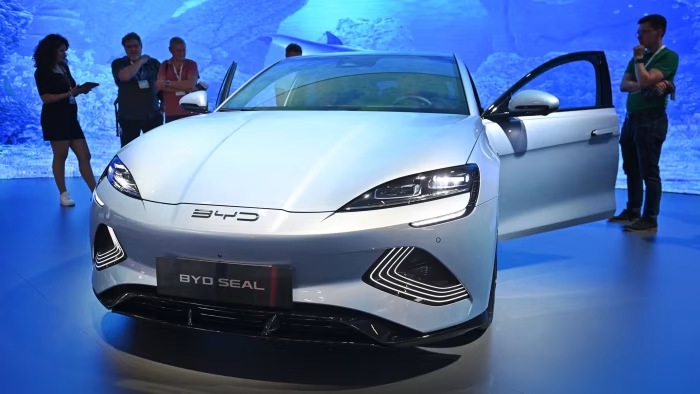
In-Built Technology Inside BYD EVs
1. Battery – BYD Blade Battery (LFP)
- Type: Lithium Iron Phosphate (LFP)
- Technology Name: Blade Battery
- Manufacturer: In-house by BYD
- Key Features:
- Extremely safe – resists thermal runaway and fire
- Long life – over 3000–5000 charge cycles
- No cobalt – cheaper and more sustainable
- Slim and strong – cells are long and blade-shaped, stacked inside the pack for efficient use of space
Use Case: Ideal for EVs in hot climates or fleet usage due to its longevity and stability.
2. Electric Motor – Permanent Magnet Synchronous Motor (PMSM)
- Type: Mostly PMSM, not induction motor
- Why Not Induction Motor?: PMSMs are more efficient and compact, especially at lower speeds.
- Benefits:
- High power density
- High efficiency over wide RPM range
- Lower energy loss compared to induction motors
Some commercial models or buses may use induction motors, but passenger BYD cars generally use PMSMs.
3. Inverter – Integrated Silicon Carbide (SiC) Inverter
- Function: Converts DC from the battery to AC for the motor
- Technology:
- Uses Silicon Carbide (SiC) MOSFETs for high efficiency
- High switching frequency = smooth motor control and faster response
- Integrated with motor controller for compact packaging
Result: More driving range and reduced heat generation.
4. VFD (Variable Frequency Drive) – Motor Controller
- Technically, this is part of the inverter/motor control unit in EVs.
- Function:
- Controls speed and torque of the motor by varying frequency and voltage of AC power
- Enables regenerative braking
- Provides smooth acceleration and deceleration
In EVs like BYD’s, VFD = inverter + controller in one smart package.
5. Integrated Powertrain – e-Platform 3.0
BYD integrates many components into one modular unit:
- 8-in-1 design: Motor, controller (VFD), inverter, gearbox, on-board charger, DC-DC converter, and more
- Lower energy loss, better packaging
- Reduces weight and increases efficiency
6. Smart Systems & Auxiliary Tech
- Thermal Management: Active liquid cooling for battery and powertrain
- Heat Pump: Improves range in cold weather
- Vehicle Control Unit (VCU): Manages power delivery, regenerative braking, and charging
- Drive-by-wire systems in new generation platforms
Summary Table
| Component | Technology Used | Notes |
|---|---|---|
| Battery | LFP Blade Battery | Long-life, safe, no cobalt |
| Motor | PMSM (not induction) | Efficient, compact, high torque |
| Inverter | SiC-based integrated inverter | Efficient, high-speed switching |
| VFD | Integrated with inverter (motor controller) | Smooth drive, regen braking |
| Powertrain | e-Platform 3.0 (8-in-1 system) | Modular, lightweight, thermally optimized |
| Auxiliary Systems | Thermal management, heat pump, OTA | Enhances range, safety, and software updates |


